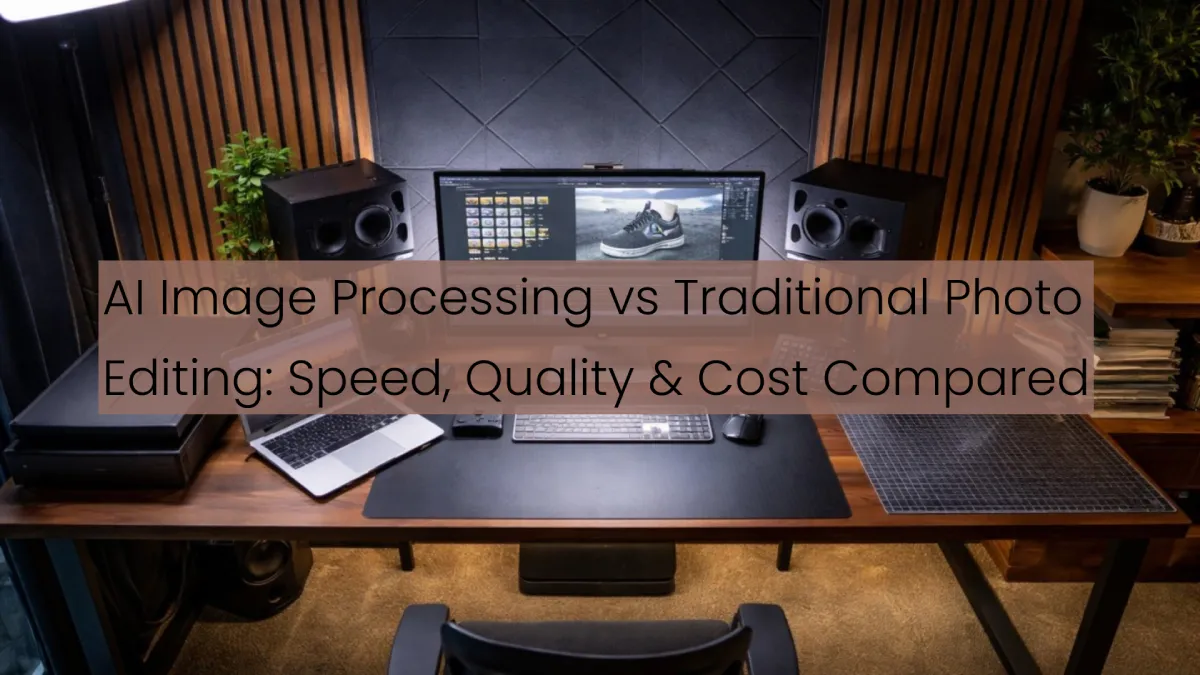
AI image processing and traditional photo editing solve different problems, and both have their distinct advantages.
Traditional editing is critical for situations where creativity, fine detail, and high-end quality are the most important. It follows a fine-tuned precision and maximum high-end quality editing. AI editing, on the other hand, allows businesses the ability to quickly and consistently edit vast amounts of photos, which is not possible in traditional editing.
Instead of choosing one or the other, modern editing has combined both traditional and AI editing workflows. To make an informed decision, this article compares the speed, quality, and cost of traditional and AI editing. We will illustrate the ability of Omnimage to offer the benefits of both editing methods, so businesses can edit photos and also maintain high-quality standards in high volumes.
What Is Traditional Photo Editing?
Traditional photo editing is a manual process of image adjustments. It includes processes like cropping, color corrections, retouching, and exposure adjustments. This requires the use of tools like Adobe Photoshop, Lightroom, and GIMP.
Traditional photo editing procedures include working with RAW files, adjusting the exposure and colors, and making local modifications. The final step in traditional photo editing is to combine the results of several retouching techniques. It includes processes like masking, dodging, and burning. Overall, the traditional photo editing approach provides complete creative control and personalized output.
The main drawback of traditional photo editing is the time it takes to process each image. Each photo takes time and scales that work. This leads to hiring more editors, production time expands, or more budget for outsourcing. When the volume of images reaches thousands, traditional bottlenecks become operational blockers.
What Is AI Image Processing?
AI image processing can be described as applying machine learning algorithms to analyze and edit images without human input. Humans are typically required to alter images by hand selecting outlines, adjusting tones, and modifying layers, but AI can perform these adjustments automatically. AI photo editing can complete all these adjustments automatically by identifying subjects, separating backgrounds, optimizing lighting, enhancing resolution, and performing image corrections in a matter of seconds.
AI-based image processing tools can recognize patterns, including how to accommodate different configuration standards, as well as shape, color, and texture discrimination, all due to the large amount of data used to train the tools. Color adjustment, image resizing, shadow adjustments, and batch editing of large groups of images can all be accomplished very quickly.
AI editing is designed to scale efficiently and consistently. Unlike manual processes, AI does not require extra staff during peak business hours and can handle thousands of images without slowing down. AI editors can process thousands of images without losing speed or compromising the quality of editing.
Speed Comparison - AI vs Traditional Editing
In terms of turnaround time, AI editing has a clear advantage. In many high-volume workflows, AI can reduce turnaround time significantly compared with manual editing. Even for simpler adjustments, AI provides a significant speed advantage.
On the other hand, Traditional editing requires precision and creative intent. Skilled editors make context-aware decisions that AI may occasionally miss.
AI vs Traditional Editing: Speed and Workflow Comparison
| Features | AI Editing | Traditional Editing |
|---|---|---|
| Background Removal / Sky Replacement | Automated in seconds for high-volume workflows. | Manual masking offers greater control but takes longer per image. |
| Batch Processing / Bulk Edits | AI processes hundreds or thousands of images at once with consistent results. | In traditional editing, professionals need to repeat the adjustments multiple times. |
| Simple Adjustments (Crop, Straighten) | AI speeds up the minor edits, mostly for the large batch of images. | Humans can do these edits, but it takes a little bit more time than AI does |
| Precision & Creative Control | AI is good, but it may miss subtle artistic details. | Humans excel, making context-aware, nuanced adjustments. |
| Learning Curve | Easy to use, and anyone can get polished results in seconds | Requires practice to master professional software. |
| Consistency | AI applies to edits uniformly across all images. | The result can differ depending on the editor |
Platforms like Omnimage take this further by combining bulk AI image processing with professional-grade refinement workflows. This improves delivery time, reduces delays, and enhances overall business efficiency.
For e-commerce teams, slow image production does more than delay editing. It can delay product launches, seasonal campaigns, marketplace updates, A/B testing, and catalog expansion.
| Factor | Traditional Photo Editing | Omnimage AI |
|---|---|---|
| Editing Time per Image | 5-30 minutes per image | Seconds per image |
| Processing 1,000 Images | Several days to weeks | Minutes to under an hour |
| Workflow | Manual editing by designers | Automated batch processing |
| Scalability | Limited by team size | Handles thousands instantly |
| Campaign Turnaround | Slower launch timelines | Faster product launches |
Quality Comparison - Can AI Match Human Editors?
AI has changed how we edit photos across the photography industry. While it cannot fully replicate human creativity and emotional depth, it significantly improves speed, consistency, and technical quality. Human involvement is still necessary for final refinements and maintaining brand reputation.
The main focus of AI is to be fast and accurate. When using a platform like Omnimage, you get a hybrid workflow that combines automated efficiency with human creativity. This helps maintain both quality standards and creative control, which is essential for customer satisfaction and long-term product value.
| Factor | Traditional Photo Editing | AI Image Processing |
|---|---|---|
| Creative Control | High artistic control | Limited creative interpretation |
| Edge Detection | Manual precision | Advanced AI edge detection |
| Consistency | Can vary by editor | Highly consistent results |
| Detail Handling | Strong for complex scenes | Strong for structured product images |
| E-commerce Readiness | Requires manual adjustments | Automatically optimized for marketplaces |
Cost Comparison - Which Saves You More Money?
The price of editing photos can vary a great deal based on whether you do it by hand or with AI tools. There are numerous hidden costs associated with traditional editing.
It includes the cost of editing each image, the cost of retouching, the cost of renting a studio, the cost of hiring a photographer, and even the cost of reshooting if something goes wrong. These expenses mount up rapidly as the number of photos rises.
Scaling with more editors or agencies increases expenses and can become problematic for organizations.
However, AI image processing typically operates on a subscription basis. Over time, this makes it far less expensive. For the most part, you don't need a studio or reshoots, which saves money and time.
Because of this, AI is a more affordable option, particularly for e-commerce companies that deal with massive image volumes. You save more as you scale, and those savings keep increasing over time.

| Cost Element | Traditional Photo Editing | AI Image Processing |
|---|---|---|
| Studio Rental | Required for shoots | Not required |
| Photographer Fees | Required | Not required |
| Retouching Costs | Per image editing fees | Included in subscription |
| Reshoot Costs | Possible when images fail | Rare due to the digital generation |
| Scaling Costs | Higher with more images | Low marginal cost per image |
When Should You Use Traditional Photo Editing?
The option of traditional photo editing methods is best when you want to have full control over a project and want it to be a high-end finished product. This includes fine art photography, commercial photography, and portrait photography, as well as editing RAW photo files. You can consider Traditional photo editing when:
- Editing a RAW photo file, you have access to all of the image data and can make precise adjustments to brightness and contrast, and make adjustments to colors.
- Performing fine art photo edits, artistic control may affect the image's brand reputation or the customers' overall satisfaction. Examples could include sky replacements or adjustments to colors.
- Editing a photo to make it fit a commercial or print deliverable, and you need to ensure the image has the appropriate level of accuracy, resolution, and overall quality.
- When you want to make edits to a photo to remove objects and are using non-destructive editing methods (particularly masks) to achieve pixel-perfection.
- For high-volume editing, AI helps meet deadlines and control costs.
- Minimal edits in photojournalism or edits in documentation that is presented to clients, to retain the integrity and authenticity of the project, thereby reducing the impact of reputational risk.
- For social media or rapid-turnaround edits, speed is often more important than manual perfection.
- On a hybrid workflow that will use AI for bulk clean-up and traditional photo editing for quality, to create compliance, and improve overall customer satisfaction
When Should You Use AI Image Processing?
Automated AI image processing is ideal when you want to automate the processing of a large volume of images. AI image processing tools are fastest when performing large numbers of the same tasks. AI-powered image editing tools are essential for:
- High-Volume Product Catalogs: AI is ideal for bulk e-commerce images requiring uniform background removal, resizing, or basic enhancements across hundreds of photos.
- Real Estate Photography: Quick virtual staging, sky replacement, or property condition assessments benefit from automated AI workflows.
- Social Media & Marketing Visuals: Rapid batch edits, lifestyle mockups, or color corrections can be handled efficiently by AI.
- Initial Workflow Stages: Tasks like noise reduction, exposure auto-fixes, and object detection are faster and more consistent with AI.
- High-Volume Architectural Visualization: AI speeds up routine edits in large rendering or retouching pipelines, saving hours of manual work.
- Hybrid Workflows: Use AI for bulk cleanup and humans for hero shots, client-specific tweaks, and creative polishing.
- Tight Deadlines or Budget Constraints: AI provides fast, consistent results when speed or cost is a priority.
- Non-Expert Users: Image processing AI tools allow users without advanced editing skills to produce polished content quickly.
AI vs Traditional Editing for E-commerce Businesses
If your priority is speed and cost-effective processing of large volumes of images, then AI is a better option. If your priority is providing custom artwork with a high-end and premium brand presentation, then manual editing is the better option.
Most businesses today take a middle ground. AI can take care of the bulk of the editing, and then people can finish the last edits to the images that will have the greatest impact.
| Feature | AI Editing Strengths | Traditional Editing Strengths |
|---|---|---|
| Speed | Edits hundreds of images in minutes; perfect for high-volume catalogs | 15–30 min/image; scales poorly |
| Cost | $0.001-$0.30/image; subscription-based, minimal labor needed | $1–5/image; labor-intensive |
| Consistency | Uniform results across catalogs | Varies by the editor's skill |
| Quality | Excellent for backgrounds, lighting, and batch enhancements; minor artifacts are possible | Pixel-perfect, nuanced brand matching |
| Scalability | Handles thousands of SKUs effortlessly | Requires editor teams |
Which Is Right for Your Business?
It all depends on what your business goals are when it comes to AI image processing and editing photos manually. If you want to focus on speed, scale, and efficiency, then you should consider engaging in AI image processing to meet these needs. Nevertheless, you can still benefit from traditional editing for more detailed and brand-focused results.
In most commercial workflows, the strongest approach is a hybrid one. You can use AI for bulk tasks and do the manual editing for final refinements. By using platforms like Omnimage make this simple by delivering speed without compromising the quality and quantity.
Conclusion
AI image processing and traditional photo editing are not direct replacements for one another. They serve different roles in modern visual production. Traditional editing remains essential for high-control creative work, while AI is better suited for speed, consistency, and scale.
For most e-commerce and retail teams, the most effective model is a hybrid workflow that uses AI for volume and human expertise for refinement. That is where platforms like Omnimage create the most value.
Platforms like Omnimage make this easy by combining professional-quality outputs with automation. This lets businesses grow faster, save money, and keep up with visual standards.
Frequently Asked Questions
Is AI image processing better than traditional photo editing?
AI image processing speeds up the work by handling repetitive tasks. On the other hand, traditional editing offers artistic control. Both methods have their individual specialties. You can also consider AI-based solutions like Omnimage, then add some personal touch to the image.
Can AI replace professional photo editors?
AI cannot fully replace professional editors; it primarily automates repetitive tasks. The AI for background removal and adjusting light, as well as editing the size and color, is fine, but it cannot replace the majority of human editing. Many companies use AI for bulk editing and add the final touch through their professionals.
How much cheaper is AI image processing vs hiring a photographer?
The cost of AI Image processing is significantly cheaper than that of a traditional photographer's services. With AI, creating 200 product images can cost about the same as 20, whereas traditional editing costs rise with each additional image. Solutions like Omnimage AI image processing services only cost a few cents per image processed, making it a go-to for high-volume business clients.
Is AI photo editing good enough for e-commerce?
The answer is Yes. AI photo editing is good for e-commerce. It offers a balance of speed and cost-efficiency, and quality optimization. In many cases, AI-edited commerce visuals are becoming increasingly difficult for shoppers to distinguish from traditionally produced images.
How fast is AI image processing compared to manual editing?
AI image processing is way faster than manual editing. AI solutions deliver results in seconds compared to human editing. It takes a human to edit a single complex image in nearly 20-60 minutes.
What types of images work best with AI processing?
AI works best for structured and repetitive images like e-commerce photos with clean backgrounds. It is effective when consistency is necessary across large volumes. AI works best with images that have clear subjects and high contrast.
Do I need design skills to use AI image processing?
The answer is No. You don't have to have design skills to use AI Image Processing. Omnimage does the hard work for you and allows you to easily create high-quality professional images in a matter of minutes.